
FREE SPECIAL REPORT
The Quantum Race Has a New Entry Point
Governments are writing billion-dollar checks. Nvidia just lit the sector on fire. Meet the two pure-play quantum names building the infrastructure of tomorrow's defense and computing landscape.
THE BIG PICTURE
Quantum computing just crossed from science fiction to defense reality
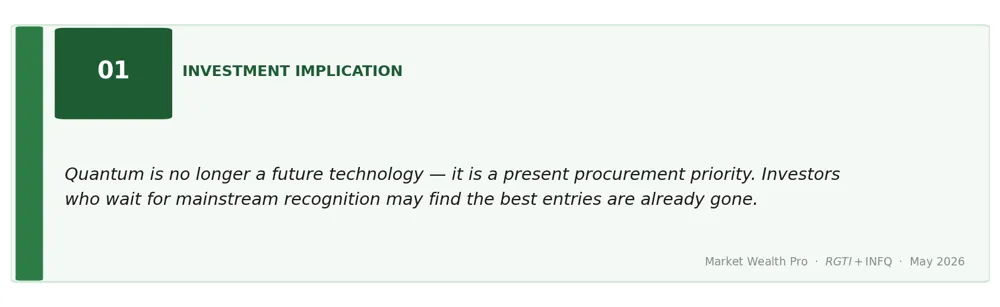
For years, quantum computing lived in the realm of laboratory experiments, academic papers, and breathless futurism. That era is ending. In April 2026, Nvidia launched a family of open-source quantum AI models — 2.5x faster and 3x more accurate than previous approaches — and sent the entire quantum sector surging. But the Nvidia catalyst wasn't the story. It was the confirmation of a story already being written in government contracts, hardware milestones, and quiet deals between quantum startups and some of the most powerful defense contractors on earth.
Two stocks sit at the center of this shift: Rigetti Computing (NASDAQ: RGTI) and Infleqtion (NYSE: INFQ). One is building the most credible superconducting quantum hardware roadmap outside of IBM and Google. The other is already shipping quantum sensing hardware to the U.S. Navy, DARPA, and — critically — directly into Lockheed Martin's defense systems as a key component supplier. Together, they offer two distinct flavors of exposure to a technology race that governments are now treating as a national security priority.
RIGETTI COMPUTING - RGTI
Credible hardware. Serious runway. A roadmap that could change everything by 2027.
Rigetti is not a concept stock. It is a functioning quantum hardware company with a genuinely differentiated architecture. Rather than trying to build ever-larger monolithic chips — the approach that runs into physical limitations fast — Rigetti tiles together modular 36-qubit chiplets to create scalable systems. Its 108-qubit Cepheus-1 system, now generally available through Amazon Braket and its own Quantum Cloud Services platform, has demonstrated 99.9% two-qubit gate fidelity at blazing 28-nanosecond gate speeds. That combination of accuracy and speed is exactly what enterprise and government customers need for real-world applications.
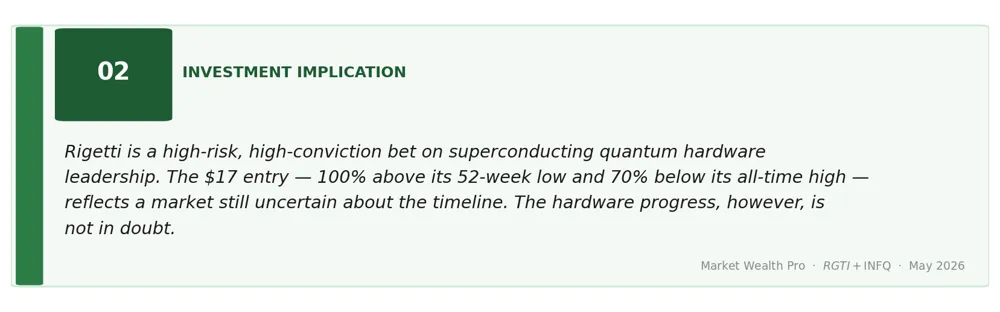
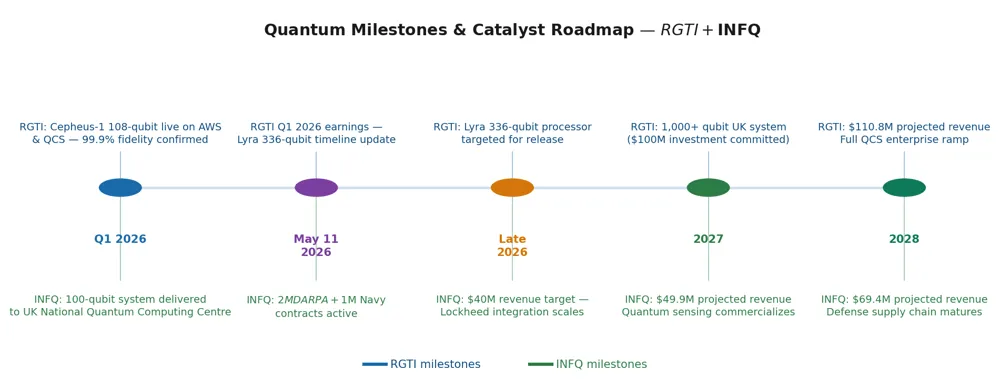
The roadmap gets even more compelling from here. A 336-qubit Lyra processor targeting 99.7% fidelity is on track for late 2026. Beyond that, Rigetti has committed up to $100 million to build a 1,000+ qubit system in the United Kingdom — a landmark that would represent a step-change in computational power. An $8.4 million purchase order from India's C-DAC for a 108-qubit system and its NVQLink compatibility with Nvidia's quantum-AI infrastructure signal that international demand and ecosystem integration are accelerating simultaneously.
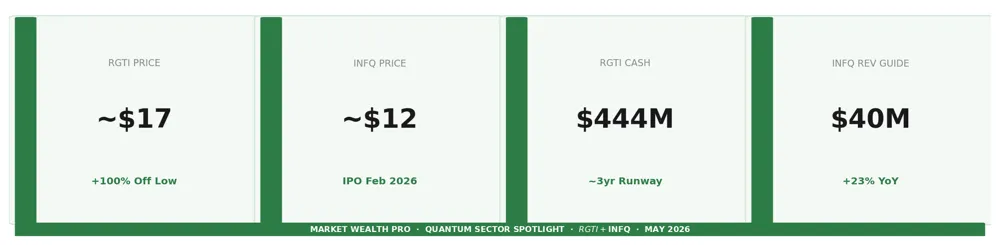
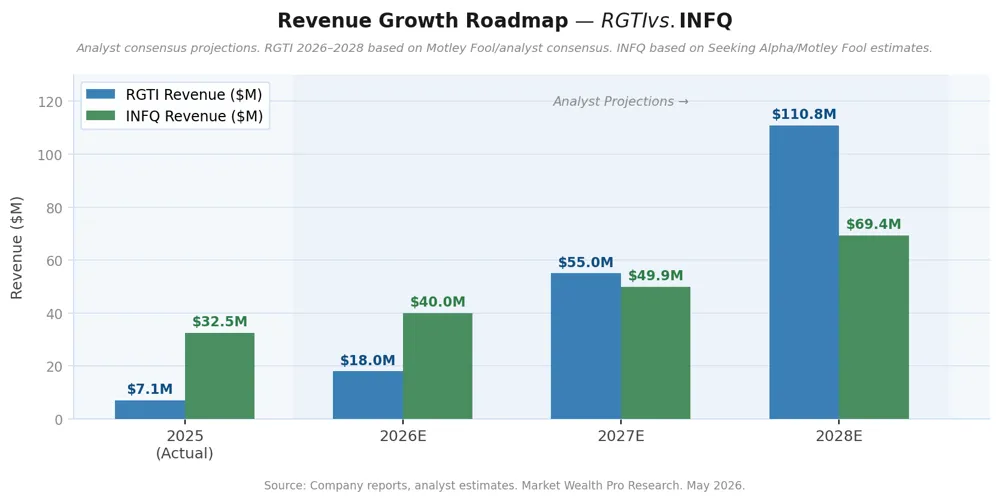
Yes, the financials are uncomfortable. FY2025 revenue came in at $7.1 million — down 56% year-over-year — and the company is deeply unprofitable. Analysts project revenue rising to $110.8 million by 2028, but that requires significant execution. What keeps the bull case alive is the balance sheet: approximately $444 million in liquidity provides roughly three years of runway, giving Rigetti the time it needs to prove out the Lyra processor and convert its hardware credibility into sustained commercial contracts. Q1 2026 earnings land on May 11 — the next major signpost.
INFLEXTION - INFQ
The "backdoor" quantum company already embedded in U.S. defense systems
While Rigetti competes for computing supremacy, Infleqtion is playing an entirely different and arguably more immediate game. The Louisville, Colorado company — formerly ColdQuanta, rebranded in January 2026 and public since February — has built its business around neutral-atom quantum technology. Its quantum clocks, sensors, and precision timing systems are the kind of components that military platforms desperately need as GPS jamming and electronic warfare become standard features of modern conflict.
What makes Infleqtion uniquely interesting is CEO Matthew Kinsella's "prime integration backdoor" strategy. Rather than chasing slow, multi-year Department of Defense programs of record, Infleqtion inserts its quantum clock and sensing components directly into systems that prime contractors like Lockheed Martin are already building. Lockheed integrates these components into navigation and timing subsystems for aircraft, missiles, and ships. It's a faster path to revenue and a stealthier path to scale — becoming critical infrastructure inside systems the military already buys, without needing to win the prime contract itself.
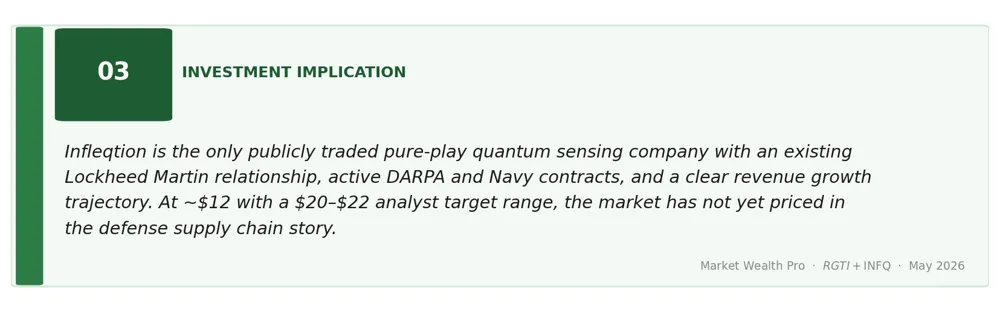
The contract wins are stacking up. A $2 million DARPA award for its Multistaq quantum sensing platform, a $1 million U.S. Navy contract for its QuIRC RF signal processing software, and delivery of its first 100-qubit system to the UK's National Quantum Computing Centre in March 2026 show a company moving from promise to production. Revenue reached $32.5 million in 2025, and management is guiding to $40 million in 2026 — a 23% increase — with analysts projecting continued acceleration to $49.9 million in 2027 and $69.4 million in 2028. Operating losses are narrowing, from $53 million in 2024 to $35.3 million in 2025. Citigroup initiated coverage with a Buy rating and a $20 price target in April 2026 — implying roughly 60% upside from current levels.
INFLEXTION - INFQ
These are not stocks for the faint of heart — here's what to watch
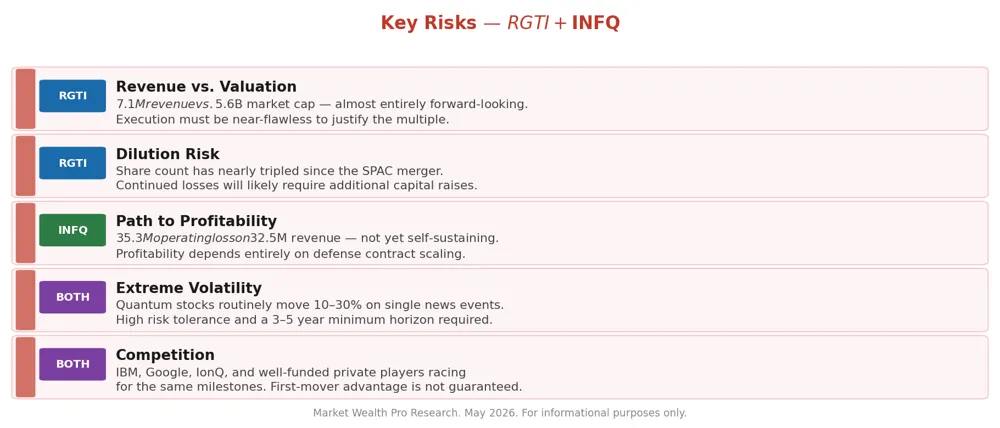
The quantum sector is not for everyone. These are high-volatility, pre-profitability names where the thesis lives entirely in the future. But for investors with a long time horizon and an appetite for asymmetric risk, the entry window may be unusually attractive right now. RGTI has already doubled from its 52-week low. INFQ is still trading below its IPO price. Both are operating in a sector that the U.S. government, allied governments, and now Nvidia are collectively treating as a generational priority. The tailwind is real. The risk is real. Position accordingly.
News From Our Partners

Executive Order 14330: Trump’s Biggest Yet
The Oxford Group

New AI Breakthrough Shocks Tech World
InvestorPlace

This Could Be Your Only Chance to Claim a Stake in Elon Musk's SpaceX
Brownstone Research

How the Rich Retire
The Oxford Group
Disclaimer: This article is for informational and educational purposes only and should not be considered financial advice. RGTI and INFQ are speculative, pre-profitability stocks with significant risk of loss. Always conduct your own research and consult with a qualified financial advisor before making investment decisions.